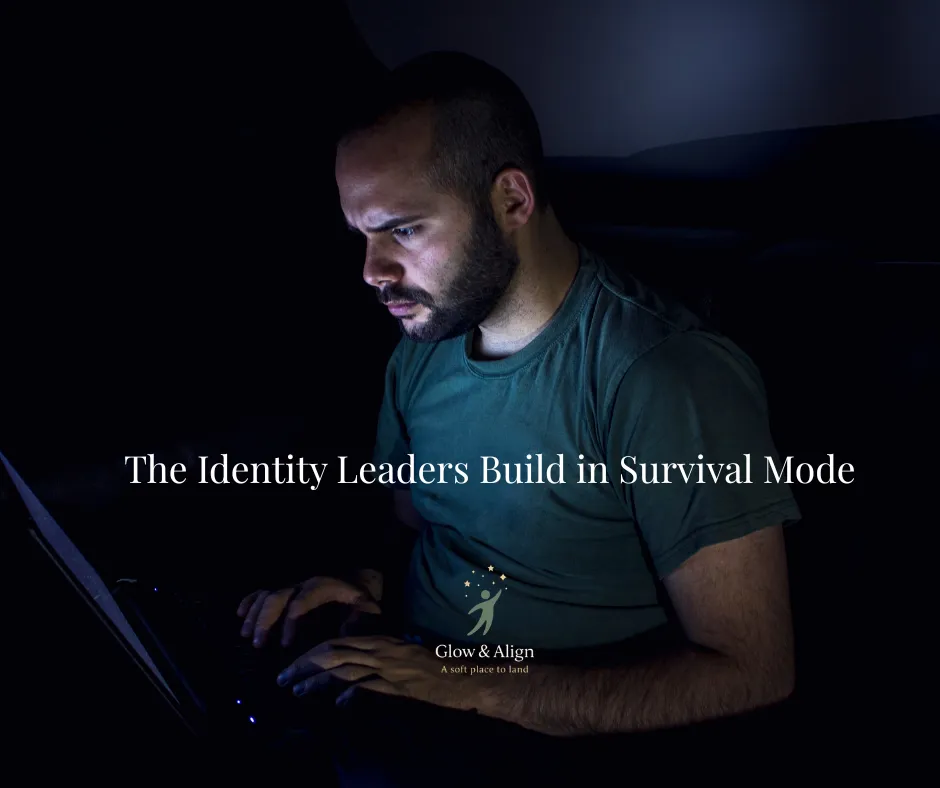
The Identity Leaders Build in Survival Mode
There is a version of leadership that forms under pressure.
It develops quietly, often during seasons when performance is required but stability is missing.
Deadlines pile up.
Expectations increase.
Responsibility expands faster than capacity.
In those moments, most leaders do what capable people always do:
They adapt.
They become more disciplined.
More focused.
More resilient.
From the outside, it looks like growth.
But internally, something more subtle is happening.
An identity is forming.
The Identity Built to Survive
Survival-mode leadership identities are rarely intentional.
They emerge as responses to pressure.
A leader learns to:
Push through fatigue.
Carry more responsibility without support.
Solve problems quickly before uncertainty spreads.
Over time, these behaviors stop feeling temporary.
They become structural.
What began as adaptation becomes identity.
The leader is no longer someone navigating pressure.
They are someone defined by it.
Why Survival Identities Work So Well
Survival identities are incredibly effective in the short term.
They produce results.
They help leaders move teams through crisis.
They create momentum during unstable seasons.
They keep organizations functioning when systems break down.
Which is why they are rarely questioned.
The very identity that helped someone succeed often becomes the one they remain loyal to.
Even long after the pressure that created it has passed.
The Hidden Cost
Eventually, the environment changes.
The crisis ends.
The organization stabilizes.
The leader enters a season that requires something different.
But the identity remains.
And this is where friction begins.
Decisions feel heavier than they should.
Rest becomes difficult.
Intensity becomes the default mode of operation.
Not because the leader lacks capability.
But because the identity they built was designed for survival — not sustainability.
When Leadership Outgrows Its Identity
At some point, many leaders begin sensing something subtle:
The version of themselves that once created momentum is now creating constraint.
They can still perform.
But performance requires the same pressure that once fueled them.
This is where many high performers assume the solution is discipline.
More structure.
More productivity.
More control.
But often the issue isn’t discipline.
It’s identity.
Identity Architecture
Leadership doesn’t just operate through strategy or skill.
It operates through identity architecture.
The internal structure that shapes how someone:
Responds to pressure
Interprets responsibility
Defines commitment
When that architecture was built during survival, intensity often becomes the primary fuel source.
And while intensity can sustain performance for a time, it rarely creates stability.
Stability requires something different.
Alignment.
The Shift Leaders Eventually Make
The next stage of leadership isn’t about abandoning the identity that once helped you survive.
It’s about recognizing when that identity is no longer the structure your leadership requires.
This transition is rarely dramatic.
It begins quietly.
A leader notices that intensity is no longer the only way forward.
That clarity can replace pressure.
That stability can replace urgency.
That leadership can operate from integrity rather than survival.
Closing
Many leaders assume growth means becoming stronger versions of the identity that carried them through pressure.
But real leadership evolution often requires something else.
The willingness to redesign the structure underneath that identity.
Because the identity that helped you survive one season
is not always the one meant to lead the next.
If this idea resonates, you may find the Identity Shift Journal useful.
It’s a short reflection designed to help you explore how your leadership identity formed—and whether it still reflects the season you’re leading in.


