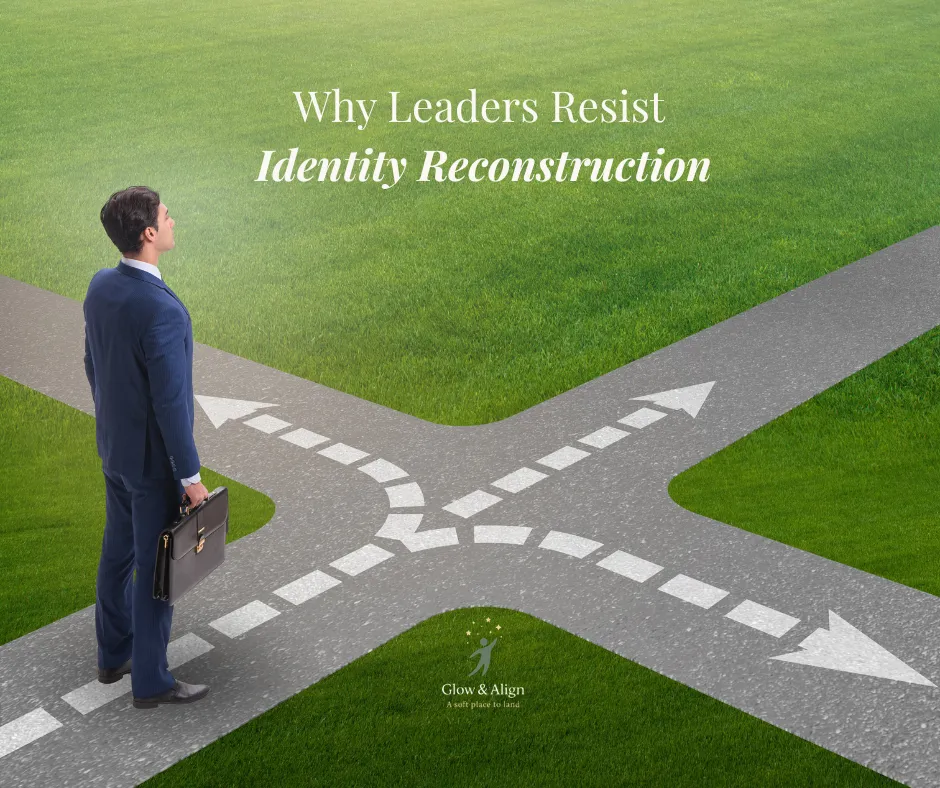
Why Leaders Resist Identity Reconstruction
Not because they lack awareness.
And not because they lack discipline.
In many cases, the resistance comes from something far more human.
Loyalty.
Loyalty to the identity that once carried them through pressure.
The Identity That Helped You Survive
Most leadership identities are not designed deliberately.
They are built during seasons that require adaptation.
Pressure increases.
Expectations grow.
Responsibility expands quickly.
And the leader adapts.
They become more decisive.
More disciplined.
More resilient.
Over time, these behaviors evolve into identity.
Not simply something the leader does.
But someone they believe themselves to be.
When Success Reinforces the Structure
The challenge is that survival identities often work.
They produce results.
They help leaders navigate uncertainty.
They create momentum in unstable environments.
They demonstrate strength when others rely on it.
Which means the identity becomes validated.
Not only internally.
But externally.
Colleagues admire the resilience.
Organizations reward the intensity.
Performance reinforces the pattern.
And slowly, the identity becomes more than a strategy.
It becomes the leader’s sense of self.
Why Reconstruction Feels Like Loss
At some point, many leaders begin sensing that the identity that once helped them succeed is now creating friction.
Intensity becomes exhausting.
Decisions require more effort.
Leadership feels heavier than it once did.
Yet even when this realization emerges, reconstruction rarely happens immediately.
Because changing the identity can feel like abandoning the version of yourself that survived the hardest seasons.
The one that held everything together.
The one that carried responsibility when others could not.
Letting go of that identity can feel less like growth and more like betrayal.
The Quiet Shift
But identity reconstruction rarely requires rejecting the past.
It requires integrating it.
The resilience that once carried you through pressure does not disappear.
It becomes part of a more stable structure.
A structure where leadership is no longer fueled primarily by urgency.
Where clarity replaces constant intensity.
Where decisions come from alignment rather than pressure.
This is the beginning of a different leadership identity.
Not built in reaction to circumstances.
But shaped intentionally.
The Threshold
Many leaders sense when this transition is beginning.
They feel the pull toward a quieter kind of leadership.
One that no longer depends on the identity that survived pressure.
But this moment often requires patience.
Because the identity that once protected you deserves acknowledgment before it can be redesigned.
And reconstruction takes time.
Not because leaders lack capability.
But because identity architecture evolves through integration, not force.
Closing
Leadership evolution rarely begins with strategy. It begins when a leader recognizes that the identity that once sustained their leadership is no longer the structure their next season requires. And when that recognition happens, the work is no longer about pushing harder. It becomes about redesigning the architecture beneath the role. Sustainable leadership doesn’t begin with changing behavior. It begins with understanding the architecture that produces it.
You can explore that model here: → The Identity Architecture Model


